Dan Gerstein

Introducing Free Stars: Children of Infinity

In our bubbling cauldron which is the potion that will be UQM2, we have been adding the odds and ends we need for the game. Design and audiovisual content are like ingredients which add foundational magic but are there to be enjoyed later. Sometimes, though, we add a big, phosphorus ingredient, spilling out some awesome theatrical fog that curls all over the stage. Behold:

To continue our Halloween-themed metaphor, follow us, the cackling witches, as you imagine gnarled fingers beckoning you forward: “Walk with us, and inhale the wonders of our brew.”

Children of Infinity

Free Stars: Children of Infinity logo

When we finished pre-production a few months ago, we knew we were ready to create a fitting title. The Ur-Quan Masters was a solid subtitle for the original game, describing the main threat, and evoking its epic themes about freedom versus servitude. We searched for another name that would hint at what this new story is about and how the game might feel. With the story finished, we decided on Children of Infinity to describe the adventure awaiting you after vanquishing The Ur-Quan Masters. Let the speculation begin!

Free Stars:

For fans of UQM, we hope you’ll immediately understand the inspiration behind the name for our series. Following the Title: Subtitle paradigm, we wanted a phrase to tie our whole saga together without boxing in our story. If The Ur-Quan Masters was about the Ur-Quan, then the series is really about the Alliance of Free Stars, implying an iconic cast of characters, and their many adventures through hyperspace and beyond. 

By adopting Free Stars as the name of our series and setting, we have a direct way to talk about all of our games that we’ve worked on. After all, we don’t want to claim games we didn’t work on, let alone stories that aren’t connected to our multiverse. We want to identify which stories and games are ours and continue building our saga around the Alliance of Free Stars, from The Ur-Quan Masters to Children of Infinity.

Names are Hard!

We look forward to sharing a write-up of how we came up with these names and the hundreds we didn’t wind up using. The short version is that we tried to put a lot of thought and care into our choices. For example, the most obvious choice – The Ur-Quan Masters 2 – doesn’t make sense given our new story’s focus. Even with all that, names are inherently subjective. The same word can have different connotations and meanings as we go between cultures and languages. While we had fun trying to find some words that satisfied our own ideas, words are really about communication, and we hope it conveys our vision for this game. After all, this is the title of a game that we are making for others to play. We truly hope you’re as excited as we are.

Broadening Our Reach

Free Stars: The Ur-Quan Masters splash logo by Robert Mauritson

If you’re reading this, you already know at least a little about our development. Maybe you even support us on Patreon or hang out in our Discord! If you do, you must be exceedingly attractive and intelligent (we collect a lot of analytics). However, not everyone may know about Children of Infinity, much less The Ur-Quan Masters! We want to start taking opportunities to get the word out, and it’s important for us to create a presence online, so that people can have a chance to hear about us, with fun, weird, and enjoyable places to grab on to. You’ve seen some of that with our ongoing social media presence, but it’s time for something meatier (Dan is vegetarian and apologizes for not finding a suitable replacement word… veggier?).

The Ur-Quan Masters – Now on Steam

First off, we’ve taken the steps to get the previous game on Steam, which now has the full title, Free Stars: The Ur-Quan Masters. While UQM was – and always can be – available elsewhere, having a presence on Steam for UQM is helpful in a few ways. It’s a place where we can showcase the work of our community in maintaining UQM and maybe even help it reach new audiences. It also lets us establish a presence for the whole series. If game number 1 is on Steam, when game number 2 is coming, we can tie them together nicely in a way both new and old players can understand. Book stores, as an analogy, usually put each book in a series sitting next to each other on a shelf, and we want to do the same.

A Game Website

Secondly, we have an actual website for Free Stars now. It reveals at least a few things no one has seen before, and as we share more and more of Children of Infinity, we will continue to grow it with content soon. We want it to be a home for the series and take one more step to making this sequel a reality, especially for the fans who don’t even know there’s a sequel coming, or even the new fans who might learn about this series. Lastly, as we talk about the game to other people, it is a helpful tool to remind everyone of the legacy and influence of the original UQM. There’s a reason we’re all here and excited to work on or play a sequel.

Coming Soon

Chmmr fighting an Ilwrath in Melee in Free Stars: Children of Infinity

Now that we have all of this in the open, we are only going to build on it. Stay tuned for more cool things coming, including our 31st anniversary next month. We need your help too! Please share links to this blog post, to UQM on Steam, and our website for Free Stars. Remember, like Will Rogers said, “Someone who hasn’t played UQM is just a fan who doesn’t know it yet.”

Thank you for reading, and please come join the discussion on Patreon, Reddit, and Discord.

Introducing Free Stars: Children of Infinity Read More »

No Longer Waiting for Godot

What’s in an Engine?

A little bit of background: when we charted our course for UQM2 and Pistol Shrimp, one of our guiding principles was “own what we make.” That had a lot of meanings, but it directly pointed to building our own technology, and leveraging other open-source technologies. Fred was passionate about making Simple, our tool for creating gameplay and netplay. Working together, Ken started creating tools to apply audiovisual layers on top.

We are well aware of a lot of game development technologies, having worked with them professionally or as tinkerers. Unity and Unreal are two of the most familiar proprietary packages, while GameMaker is another, accessible starting point. Simple actually ran within Unity at one time in the past, too!

We could have used any of those technologies, but we didn’t. A major reason was that it would take our ownership of what we made away. The other one is a general peril of any monolithic software package: you often spend more time working around its 100 unneeded features just to use the 10 needed ones. It might have saved us time – we truly don’t know – but it would have put our project at risk in other ways. 

The recent events surrounding Unity are painful to hear about and must feel like shocks of cold water for other developers and players.

On Ownership

For better or worse, we’ve been through losing ownership many times before.

Having worked for larger companies in the past, we never really get to keep the work we’ve done. If we have a cool solution to a problem on one project, we may not be able to use it on the next. While the idea can live on in our head, the intellectual property and sweat output belongs to the company. Even technologies we license on a project may not be up to us, and the parent company (or owner of the technology) could decide we can no longer use it. We didn’t want to lose our ideas and technologies – no matter how good, bad, or otherwise – anymore.

The Ur-Quan masters is open source, and that also means no one can take it away. As long as someone is willing to port it, it can be made to run on anything. We like that. As long as Pistol Shrimp owns what we do, we can decide our own product’s destiny. We can make different platforms support it. We can release it freely. We can make sure it embodies what we want for it, even if that changes, just as UQM became open source many years after its original release.

UQM2’s needs were fairly modest, so we calculated it would be easier to build what we needed ourselves rather than buy into one of the behemoth engines. When Ken journeyed into retirement, Fred and I took stock of the remaining work. Our question was simple: without Ken, is it going to be faster to just finish in the direction we’re going, or is there another way to do this that will simplify and expedite our work? One way or another, we would have to pick up the remaining work somehow. We took a week to seriously research options, and we arrived at an answer. It was time to pivot.

Enter Godot

I (Dan) have watched and toyed with the open-source Godot engine with some interest for its relatively short lifespan. Frankly speaking, I like it, and I’ve even enjoyed a couple games that were made with it. At the end of July, I suggested to Fred that we give it a look as a potential candidate for how we would be handling our audiovisual needs.

After a week of building some proof-of-concepts, both Fred and I weren’t turned off. We might have too much experience to ever be really sold on anything, but we hadn’t found anything to terrify us, and we liked what we were able to do.

Within another week, our proof-of-concept quickly stopped being a proof-of-concept and became the answer. We had almost all of UQM2 running within Godot! Within less than a month, we had all of UQM2 functioning, as well as features we had planned but had not been able to do.

So why do we like it?

By working in a world that was more fleshed-out, we empower ourselves to not only do more work on our own, but also more readily bring in additional contributors. A few of our community members who had been working on our ProceduralPlanet toy, for example, have turned to work on a Godot implementation. That was made much simpler by having a more standardized framework for everyone to work and learn in instead of our bespoke solutions.

Godot leaves a lot to our imagination as far as how to answer tech questions. Unlike larger tools which try to provide a lot of easy answers (which are only easy if you promise to color inside the lines), it leaves a lot of implementation left to the end-user and the project. It’s “just enough engine”.

Permit me to wax philosophical for a moment. Video games – still a new idea, relatively speaking – are a marriage of technology and artwork, and the tools we use often inform the kind of art we can make. If the only tool the world had for 2d art was a pencil, we would have a lot of pencil drawings. What about paint, crayons, and inks? Massive, proprietary tools often optimize for their own solutions to problems like how a camera should work. Applying different solutions or trying to deviate becomes difficult. A ‘best practice’ becomes a solved problem, and then developers don’t have the opportunity to offer new, different ways to do it. Most importantly, tools represent the visions of creators, and we want them to be as individual and as varied as the people who use them. We celebrate the diversity of art through technology which gives people the ability to decide, for themselves, what tools, mediums, and ideas let them feel and be creative. Godot fits this spirit!

Not even last and certainly not least, Godot is available under the permissive MIT license. In the original spirit of UQM, we – and others – can build our own versions of Godot and guarantee it will be supported as long as we want. Any improvements we make to Godot or anything we build just for Godot is something we can also share outwardly as well. Simple running on Godot means there is a long future for not just UQM2, but games that haven’t even been imagined. The ProceduralPlanet toy that’s part of UQM2 is something we want to release for everyone and we hope will help someone else make their own game. Whatever we do, Pistol Shrimp and the world at large will never lose access to it or have the privileges of ownership revoked. We deeply feel that it touches the heart of our goal: “owning what we make”.

Last, for this blog post, anyway, is simply: shifting to Godot will help us finish UQM2. There’s almost no better reason than that, but, as outlined above, we hope you can appreciate our multifaceted thoughts as well.

What Did it Cost?

The short answer is: about a month. The longer answer is more nuanced. With a shift into some new technology, we had to pause, learn, and re-create some things. However, we had very few things we needed to actually re-create from scratch. Ken’s work on the game viewer already told us how we would be doing things, and it was just a matter of porting over some of those ideas. As people who work in technology may know, ideas are cheap, but proving that an idea works from front to back is the hard part. We already had done a lot of that, and going from our handmade game viewer to using Godot as a different game viewer was fairly straightforward.

There are lots of little details that are far too technical to write about here, but the other big aspect of our work is in the content. Not just code, but the actual game part a player will experience. Because so much gameplay had been built in Simple, we got to keep all of that. We had a few rendering tricks that were used in our own game viewer, but the actual content that makes a ship look like a ship had been made and just came along for the ride. Beyond that, because some of our solutions to certain things like UI were still just coming online with our current technology, we were able to build all new kinds of content we had been waiting to build until later.

While we spent about a month on the pivot, we also shot past where we were previously on other fronts during that time. We had to slow down certain aspects, but others became much faster. We started having entirely new questions about how we would do certain things because Godot enabled us to reach those milestones faster. It had given us a tool to solve so many old problems that we started uncovering new ones. That is a strong and exciting indicator of progress. We like that!

Lastly, as we touched on in the previous section, we are happy about what it didn’t cost. We’ll never have to worry about an onerous license or surprise fee that affects our future. We’ll never encounter an intractable problem because our technology is locked behind closed doors. And we’ll never have to worry about the game relying on anything that could disappear tomorrow and make it unplayable.

And We’re Off!

This would be an awfully silly blog post if we didn’t have any Godot to show you, but we’d actually like to take this opportunity to walk through everything on one of our development streams. We can show you things, you can ask questions, and we can learn what’s really exciting about these changes together. Games are built on a lot of imagination and “what could be”, and it will be much more fun to show and tell together. We’re much more interested in what you have to say than what we have to say!

Join us on Wednesday, September 27th at 11am PT at https://twitch.tv/pebby. In the meantime, feel free to join the discussion on Patreon, Discord, Twitter, or Reddit.

And thank you to everyone supporting us on Patreon for helping us continue to own what we make.

No Longer Waiting for Godot Read More »

Parting Words from Ken Ford

I have decided to step away from work.

This decision has been several years in the making, although I have — more or less effectively — avoided coming to this realization over that time.

Several life events have helped me realize that my ability to healthily — physically, mentally, and emotionally — balance my professional career with my personal life has become increasingly ineffective. Being somewhat older and somewhat wiser (or at least more aware of this lack of balance), I have come to the decision that to lead a healthier personal life, I need to step away from my career.

This is not an easy decision and, as I’ve said, I have been struggling to come to this point for several years. But once I allowed myself to see a life separate from my programming career, a lot of my anxiety and stress has eased.

I regret leaving in the middle of a project, but I think any “break up” (external or internal) is always challenging and will always feel ill-timed. In the interest of my health and serenity, this is the correct choice for me.

This decision has nothing to do with any individuals, teams, or projects. It has everything to do with me. I recently said, “Part (a lot?) of my [professional] success has been due to my frenetic pace, trying to outrun my self-doubt! And that just ain’t working any more.” I am tired, and want to “relax” and enjoy some quiet time, without work deadlines, without worrying that I am “failing”. Having never had any real computer science education (well, except for Introductory Pascal back in the early 80s!), I have always felt like an imposter. I feel I have succeeded by sheer dint of will, effort, and pace. At this point, I am exhausted.

I appreciate all who have shown me friendship, love, and support over the years. Almost to a person, I have been accepted and treated warmly throughout my career, and my current “crew” at Pistol Shrimp is no different. As I’ve stated, it’s not about “them” — it’s about me. I have never doubted the current and future success of any team I have been a part of, and that continues. But my future success needs to be based on more than my ability to think, react (and type!) quickly. Although slightly chagrined at realizing I’m just not producing work (or enjoyment) at the level I should be, I need to make this change.

Work has defined me for decades. That is probably unhealthy to the extreme to which I took it. I am grateful for what my career has afforded me, but I am relieved to look at a life beyond work. I suppose I may miss the daily challenges of work. Then again, maybe not! But I am looking forward to different challenges: helping my kids build their careers/lives, reading all those books I’ve been meaning to (and maybe getting the gumption to try writing one myself?!), becoming world renowned for my fantasy sports success 🙂. Mostly, though, I’m simply looking forward to not feeling inadequate for and overwhelmed by the tasks in front of me, whatever they may be.

Thanks again to any and all who have trudged alongside me on this journey. I couldn’t have done it without you!

Regards,
Ken

Parting Words from Ken Ford Read More »

UQM2 Update – Summer 2023

Greetings, Hunams and other lifeforms. We’re coming to you with some updates after an exciting summer of effort on UQM2. Our mission at Pistol Shrimp is about creating a better environment for game development. Being open about our process is an essential way we strive for that. We want you to feel as involved, inspired, and valued as we feel!

We’ll be breaking this into a few parts because a lot has changed, and change is the only constant in the universe. Let’s start with what may come as the most radical news.

Bidding Adieu to Paul and Ken

We wanted to let you know that Paul and Ken have wrapped up their work with Pistol Shrimp and will be moving on. The four of us had been working hard in pre-production, building our tools, outlining the story, prototyping the gameplay, and setting up the studio as a company. Now that we’ve entered production, it’s time for a different set of talents to bring this project to completion.

Paul has written an amazing story which has been in progress long before Pistol Shrimp joined up. To quote Paul, himself, “These characters have been living in my head for 30 years.” They’ve even shown up in amusing places like the writing for Persephone, one of the main characters of the Skylanders cast, who speaks just like the Orz. Entire ship designs were turned into Skylanders, and even Wimbli’s Trident appeared in The Horde. Now in UQM2, we have Paul’s wonderful, new rogue’s gallery of aliens to sit alongside some of the familiar, returning cast. He can’t wait for you to meet them all.

Ken has been looking to retire for a while now after a long career, but we had lured him into giving us one go-around helping to build out our cool technology. After he helped pave the way for production work to happen, he thought it was a good time to stop. We are going to miss him, but we won’t hold him here against his will, and we knew from the beginning that this was part of our plan. We hear retirement is awfully boring, though, so he knows we’re always here if he wants to contribute again.

A Personal Message from Fred

Paul and Fred on their last day at Toys for Bob

Permit me a tortured analogy. Getting to this point I have often felt like we were collectively Odysseus. I have worked with Paul for over 30 years, Ken is my brother and off-and-on collaborator for many of those, and Dan is pretty close behind. This Odysseus-Voltron completed its Iliad, lo these many years ago, letting the Trojan Horse, UQM, do its work with Accolade and starting the quick journey home to a sequel.

Spoiler alert! Many trials and tribulations intervened (AKA careers), but the flame to return to our universe was never extinguished. In the fullness of time and circumstances we found an opportunity to reassemble. Paul with his well and truly marinated story, Dan with his unmatched design and modern gaming sensibilities, his care for the community, and his infectious enthusiasm. Ken with his dependable output, collaboration, and reasoning. And me, eating sandwiches.

Like any good tale, however, and with the goal in sight, we find our Odysseus-Voltron once again split into components. To continue the abusing and torturing of the reader: Gandalf is occupied with the Balrog. Boromir has blown the Horn of Gondor (I always knew Ken wanted the ring!). Yet the brave Hobbits, Dan and Fred,  forge onward.

Yet we are not lost! Paul has set down the story. Ken has laid the foundation for engineering success. Dan has completed the design skeleton. And sandwiches remain (including with my frequent lunch buddy, Paul)! In effect we are at the end of pre-production, where we now engage artists, animators, writers, and musicians to put the meat on the bones of the skeleton. This was part of the plan all along.

Please join Dan and me to bring this home, where we will string our bow and kill everyone else in the room!

NOTE: No Trojans were actually harmed or killed during the making of this statement. The story of the Sirens stays in Vegas.

A Personal Message from Dan

I got my start in professional game development as an intern at Toys for Bob through a mutual connection with Paul. When I started, I was interested mostly in art and animation and even did some contract work in the title they were shipping while I was there learning. When a new project rolled around, Paul suggested I try my hand at design. After spending a week of time reading a two page instruction manual, working with the amazing tool Fred had built, and getting Paul’s guidance, I made something reasonably playable. I was hired full-time and worked at Toys for Bob for 7 more projects.

Over my 12 years at TFB, I learned so much from Paul and Fred. Paul is the ultimate giver of excellent feedback. If you had something running at your desk and a controller to hand to him, he would want to see it and give you amazing insights. My contributions over the years at Toys for Bob largely were driven by trying to shape Paul’s wants and our back and forth dialogue into reality, and, before long, realizing that his voice lived permanently in my head. People tell me I sound like him sometimes, and it’s because his ideals shaped a lot of my own visions for what it means to pick up a controller and just connect with something fun. Thanks to him, one of my favorite parts of game development is what I’ll call the “last 10%,” where he helped me learn to take something functional and add or subtract little touches here and there to make the player’s experience go from walking to flying just through a collection of small pieces. That was one of Paul’s many strong suits in a nutshell: the moment-to-moment details that made huge differences for the player.

Fred was an inverse of Paul, known for ‘sheep-dogging’ (his term) around the TFB office and learning what people needed by observing their failures, moral or otherwise. Jokes aside, I think a lot of people were afraid of Fred because his unassuming nature of checking in would frighten people since Fred was always 10 steps ahead of you. But that was the point! Fred is always 10 steps ahead. Thanks to Fred, I learned to value not just the people who make the game, but the tools and processes they used. Fred envisioned and crafted an amazing tool that anyone who worked with would espouse as the best thing ever. A big ingredient in our ‘secret sauce’ was the person behind the curtain who actually made it possible for folks like us with crazy ideas to actually realize them without making it unwieldy to even try. While ‘failing fast’ has become something of a commonplace term now, I really learned from Fred how to eliminate complications and just do it. Fred is still one half of the UQM genetic material, and he carries not just the same mentality about finding the fun, but the mind, heart, and spirit of the original UQM with Pistol Shrimp.

Ken and I simply exchanged bad jokes and puns on a regular basis. He is one of the most hilarious people in the known universe, and my jokes will only get worse and more grammatically terrible without his guiding inspiration.

Conclusion: Not the Conclusion

Every member of the Pistol Shrimp team has worked alongside both Paul and Ken for much of their own professional careers. From Fred, who carries the original UQM torch as an essential part of that game and a co-conspirator with Ken, to Dan, who worked directly with Paul and learned his formative lessons on design from him at Toys for Bob. UQM2 has been a team project from the very beginning, with different members taking responsibility for different pieces. With the story complete and the design sketched out, Paul is off to his next challenge. With Ken’s work on our technology finished, he’s free to (finally!) rest.

As we look to the future, the team is incredibly excited to be able to take Paul’s story and creative vision, which we know you all care about a lot, and finish UQM2 out. We’re hard at work now with a core group of contributors:

  • Fred has created the amazing engine that supports all of UQM2’s gameplay and the work Dan has been doing already, and he’s only supporting more of what the game needs. Fred is still one half of the original UQM super-brain too.
  • Dan is building out gameplay which many of you have seen during our development streams, some of which will feel like a cozy, familiar return to UQM and some of which we want to feel fresh and new.
  • Lee has been talking weekly with Paul during the entire process to absorb the story and characters, turning them into the alien conversations you’ll experience. He’s working with the team on actually connecting that writing glue with the gameplay.
  • Danny has been building a UQM2 encyclopedia with Paul to document all the ideas that have had 30 years to germinate. He’s also making some awesome music that feels right at home in UQM2.
  • We have been working with our amazing community, which has already taken the ProceduralPlanet toy we released and has been improving it and actually integrating it with Dan’s help into UQM2.

Please join us in bidding farewell to Paul and Ken. They are irreplaceable contributors with wells of creativity, and we are so happy to have had their contributions.

Coming Up Next

This post is already quite long even though we have so much more to say. We’ll be sharing that in a series of notes coming up, but, even better, the development streams are back, baby! They won’t have the same, twice-weekly cadence that we used to have, but we miss you and we love using them to be together with our community and show our work in a fun, authentic, and inspiring way. Plus, Dan and Fred can talk at least 10 times as fast as they write.

We’re sure you’ll have questions and thoughts, and we welcome you in the discussion on Patreon, Discord, Twitter, or Reddit.

UQM2 Update – Summer 2023 Read More »

Follow Us on Social Media

Arilou from The Ur-Quan Masters, a green alien seated cross-legged on a red seat surrounded by glowing lights.

Did you know that we’re building out our social media accounts? We’ve slowly been creating some more places where you can follow us. It’s not stalking, it’s keeping in touch! For all we know, one of our communication methods could explode at the whim of the plutocrat du jour, so we figure it’s good to diversify.

You can already find us on the following channels:

We’re also cross-posting the above content on other channels (albeit with less focus):

We plan on being most active on Twitter and Discord, with regular blogs both here and on Patreon, and short stories on TikTok. (I know, we’re shocked about that last one too. It’s an experiment!)

Even though we’re intentionally keeping a few things under wraps, we’re going to be sharing more and more about The Ur-Quan Masters 2 in the coming months. For now, we’re mostly sharing Dan’s random alien thoughts and neverending nonsense. In time, we’ll also reveal more of the game, with bits of text, images, and video. The idea is to have fun and try things – just like we do with game development – to spread the word about The Ur-Quan Masters and its passionate community.

When we resume some more of our live streaming activities, you’ll still be able to find Dan at https://twitch.tv/pebby. And if the social media landscape has scared you into the deep recesses of the internet, we still have an email list you can join at https://pistolshrimpgames.com for big announcements when they come.

Follow Us on Social Media Read More »

Exploring the Planets

Treasure Planet concept from The Ur-Quan Masters 2 by Damon Czanik

Do you know how many planets were in the original UQM? No, seriously… do you? If you did, you probably read the hint book from back in the day. But anyone who played could tell you: there were a lot. We accomplished that via procedural generation. While the starmap was laid out by hand, the many planets in the many solar systems were created based on a random seed. Most modern agricultural laws block importing random seeds, but we’re in space now. No one can stop us! Take that, Argentina.

In addition to placing the planets, one of the key uses for procedural generation was in creating the planet artwork. We’re excited to be working with some amazing artists on UQM2, but we don’t think they’d be excited if we asked them to paint 10,000* different planets.

*This is not the actual number of planets in UQM2. Unless it is, but we actually don’t know it yet. That would be pretty funny if I guessed it right.

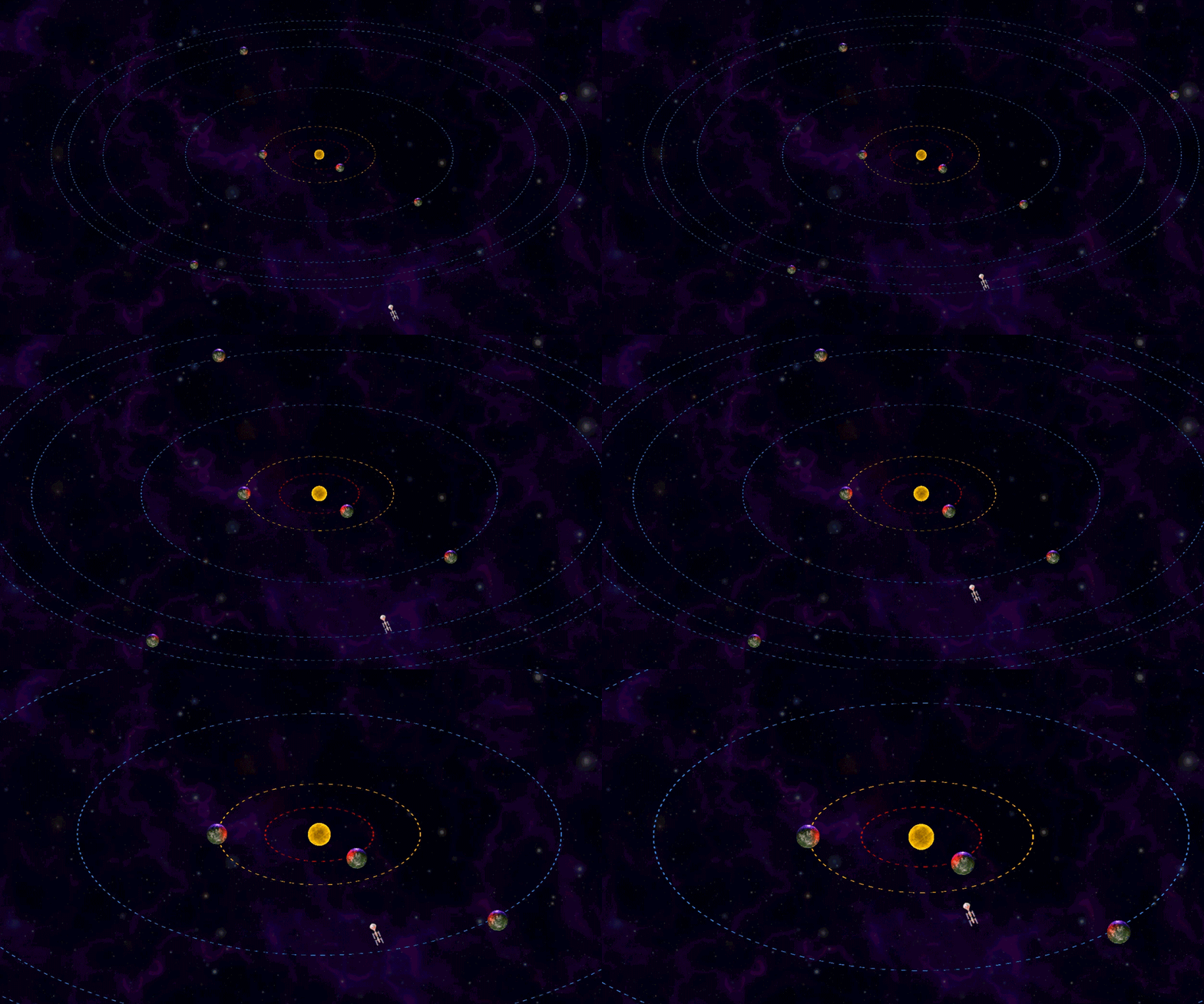
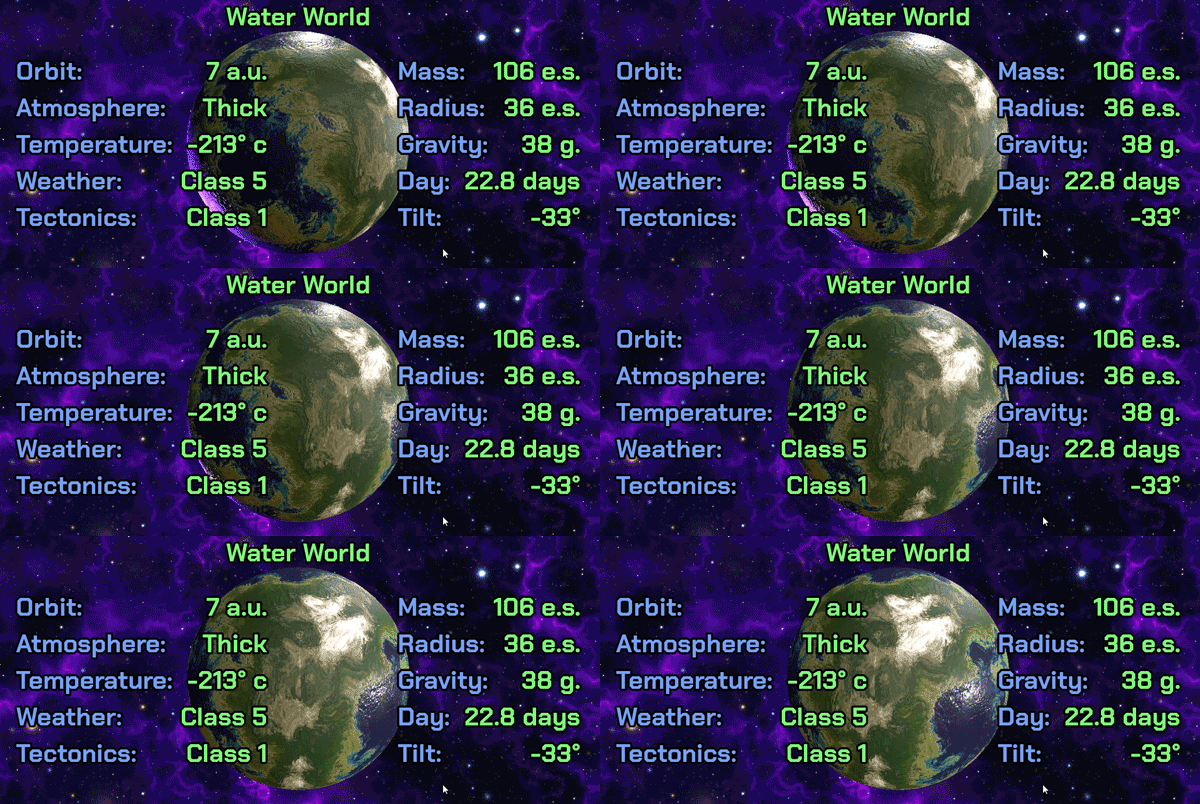
One of our artists, Damon Czanik, dug up a tool which provided a proof-of-concept for procedural generation of planets. We think we could fit these into the UQM2 universe artistically and technically, and we even found some seeds that made worlds that felt like UQM planet types. You can even go play with the tool, picking from some predefined UQM planet type seeds we like, or just trying your own seeds!

While it was a pretty good proof of concept, we knew there was more work to extend it. 

Planting the Seed(s)

Here’s what this tool shows so far:

  • It already generates planet surfaces with pretty diverse looks, but it doesn’t make gas giants.
  • Each seed always produces the same result, but it isn’t controlled in any way by something like a planet type or other parameterized knobs from our game universe (e.g. atmosphere, temperature, etc.).
  • It generates textures which can be used as flat surfaces.
  • It generates textures of different sizes, which might be able to support mip-mapping, but otherwise doesn’t have a notion of level-of-detail for that purpose.
  • It does not support optional, physical features like craters or rings.

UQM2 Goals

Using this tool as a starting point, we wanted to set some goals for how it could work in UQM2:

  • It should be able to generate many varieties of the UQM2 planet types, like the ones we know from UQM such as Emerald Worlds, Treasure Worlds, Gas Giants.
  • Each planet should be different, but exactly reproducible and recognizable by type.
  • Optional physical features can be present, like impact craters, storms on gas giants, and planetary rings.
  • Ideally, we can unwrap the orbital planet into a flat surface to use as a planetside experience.
  • Ideally, we could also use the planet being generated in interplanetary and melee views, with level-of-detail techniques to make it look acceptable when rendered at a smaller size.

UQM Planet Types

We have some modern, hand-painted concepts of UQM planet types courtesy of Damon that showcase the kinds of things we’d like to procedurally generate.

Emerald Planet concept from The Ur-Quan Masters 2 by Damon Czanik
Emerald World Concept
Treasure Planet concept from The Ur-Quan Masters 2 by Damon Czanik
Treasure World Concept
Gas Giant concept from The Ur-Quan Masters 2 by Damon Czanik
Gas Giant Concept

Discover Strange New Worlds

While creating hundreds of thousands of different planets is clearly doable, we know it can be better. The team often refers to planets as characters, where you get an evocative experience from meeting someone new, someone familiar that you like (or dread), or want to learn more about them. More than just interesting art, UQM planet types are emotional set-pieces for players to relate to.

One of our big questions is how we can get lots of our unique, fantastically or scientifically inspired planets that have their distinct, UQM character. This is where you come in!

The team has started with this general approach. Do you:

  • Have experience working with procedural generation or shaders and want to contribute to solving some of our UQM2 goals?
  • Want to make the experience of using this toy more fun in a web browser?
  • Know absolutely nothing technical but just want to show off cool-looking planets you were able to make?

If you answered yes to any of those questions, please check out the running tool, our GitHub repo, and join us in Discord if you have ideas! If you have an even better idea than what we’re starting with, we want to know that too. 

In the past, we’ve opened up our tools with distributions of Simple and our Melee prototype. They’re essential building blocks of UQM2, but they’ve been released as a way of sharing our output. The planet tool is a big step forward since we’re sharing some of our graphical techniques and able to support community input! Our goal is to collaborate on this, improve it together, and share it with everyone as part of UQM2 and beyond.

Exploring the Planets Read More »

UQM2 Update – Mid-Year 2023

Engaging HyperWave Broadcaster.
Determining send and receive frequencies.
Calculating optimal relay delivery route.
CONNECTION ESTABLISHED

>>> Submit to the will of Dogar and Kazon, vile Earthlings, or else you will never lay eyes upon your most beloved of sacred artifacts – the World’s Largest Rocking Chair of Casey, Illinois – ever again!

Carol, knock that off!

Ahem, excuse me. Our resident Umgah got ahold of the transmitter again. We’re still working on our security measures. Who’s Carol? Oh, never mind that. It’s a long story.

Greetings friends, supporters, and other many-appendaged creatures! Dan here, and I wanted to share an update on our progress, advancements, and learnings in the past 6 months, our trajectory for the near future, and really just say hi because I miss ‘seeing’ you on stream. Carol wants me to say hi and thanks for all the fish, too. Also, please stop sending us fish.

Tl;dr

If you just want the short version, here it is:

  • Pre-production – which you can think of as scoping and exploring the size of the box – has ended.
  • Production – which is filling the box – has started!
  • Our twice-weekly dev stream will be pausing for now.
  • We have some more people working with us and are doing some new kinds of work.
  • We have a plan for the fall which involves sharing a lot more content we think you’ll be excited to finally see. Because we’re producing it!

Pre-Production to Production

Production deck slide showing disciplines' work

This week, we were able to put together our first production kickoff (see above slide from that meeting)! If you’re not familiar with this kind of creative & technical development, a framing mechanism we use to separate the kinds of work we do is grouping it into pre-production and production. In broad terms:

  • Pre-production is when we are still making decisions about what we want to be making and how we should be making it. We prioritize that exploration and optimize for being able to grow, learn, and make good decisions in the future.
  • Production is when we have a firm enough idea of what to make and how to make it. We prioritize streamlining the process of getting all our creative contributions being made and woven into the actual game alongside a schedule.

That is a somewhat simplistic representation of the difference between the two, but UQM2 is more than one single piece. There are parts of our game which can be in pre-production longer or production longer, based on dependencies and schedules. The end result looks less like a clean break and more like a dovetail, sawtooth, or kraken wrestling a wooden tall ship as the dread pirate captain seeks to maintain control.

Silly diagram showing how we move from pre-production to production. Includes kraken wrestling boat.

Does that make sense? I hope so. I spent, like… 5 minutes on that drawing! That takes us to the next change.

Development Streams on Pause

If you’ve been following our live development streams, you may have noticed we’ve been unable to do them for several weeks. I love being able to share live development on stream and interact with everyone who attends, but, for the (hopefully short) time being, I have to pause them. 

First and foremost, I have lately been knee-deep in highly sensitive material that we don’t want to show you yet. Not because we don’t like it or want you to see it, but because we care about how you get to receive it. An important part of UQM2 is going to be exploration and discovery, and there are elements that we will want you to actually have fun exploring, discovering, and experiencing interactively as a player, not just as an observer. From things like the overall story to the starmap, I’m now inundated with parts of UQM2 coming to life that reach far beyond the narrow bits of work you’ve seen me do. It’s great to have them shape up and become part of the game, but it also means it’s not as easy to conceal them as I have in the past.

Secondly, since we’ve entered production, I’ve been taking on more responsibilities as what we call in games a producer. That means I’ve become responsible for getting everyone on the team what they need to make forward progress and helping prepare for the deluge of content which will be filling up our game. It’s a little bit like a project manager, but with cool mutant powers and a confusing name. I also have someone else taking on some of those design & scripting responsibilities, but more on that in a moment.

To cap it off, the plan is to pause – not stop – development streams for the near future. It’s possible I’ll be able to come out of the woodwork to do a one-off here and there if the no-spoiler stars align, but the plan is to find a way to resume once a few more cats are out of their proverbial bags. Don’t ask me where the cats came from or who even put them in the bag. I’m still trying to determine the ideal cat-bagging material.

This trade-off on streaming is coming with some more goodies for you, though. More on that at the end of this post.

Team Additions

The Orz

To help us get some of this very important production work done and support development, we have a couple new members of the UQM2 who have come on board. Our friend Danny is joining us with experience in the music industry, helping us with both audio and business development. Another former Toys for Bob-ite, Jesse Browne, is also joining to take on design and scripting responsibilities after working across many technical fields.

We’re really excited to have them on board, and they’ve already been doing some awesome work to make UQM2 even better. I’m looking forward to showcasing their work too!

Funding Updates

In our end of year update from 2022, I detailed the work ahead of us for 2023 and included funding as part of it. This is still an essential part of taking UQM2 to completion, but it deserves its own blog post describing the process, what we learned, and where we’re going. Needless to say, the same sentiment as last year is still true. We are incredibly grateful to our amazing Patreon supporters who have helped us get this far. This wouldn’t be possible – much less enjoyable – without all of you. One of the reasons we’ve been able to move into production has simply been because we can utilize all of your support to work with some amazing artists helping us! Your support goes almost entirely to funding this process.

What’s Coming Next?

We are really excited to move into production, and the other half of what we’re gearing up is our community building endeavor. We have already established an incredible community of people here who believe in us, are excited for the game, or maybe just want to see my birds and hear bad jokes. Whatever reason everyone is here so far, we don’t take that for granted. Seriously, this is the kind of thing so many artists wish for! Few things are more encouraging to me, personally, than being able to create a virtuous cycle of everyone cheering each other on.

To that end, we are going to be ramping up our own endeavors to give everyone something to get excited about this fall. We appreciate that we’ve gotten enough people here on what seems like pure enthusiasm so far, but it’s time to roll up our sleeves, unfurl our tendrils, and deliver more than just hope and imagination. We’re getting ready to show you much more, especially on the visual and world-building side. We can’t wait to show you in much more vivid detail just where we’re headed as we create an even more inclusive and enthused community.

Though I won’t be streaming, you can look forward to much more frequent communication from us, starting with posts like this but ramping up to even more of the real game content.

Side-by side of a UI doodle and UQM's Melee mode

Thank you for being on the journey with us so far, and an extra special thank you to our generous Patreon supporters. It’s only going to get better from here on out.

If you want to keep in touch more often, please join our Discord where the team and community keeps the *party* going and will welcome you with open claws.

UQM2 Update – Mid-Year 2023 Read More »

Simple Build 20230327 and Melee Prototype Release

Simple logo with a chmmr running in the melee prototype

It’s been a long, long time coming but we’re finally releasing new tools and content for our extremely patient and supportive public. If you’ve never dived into our in-development development tool, Simple, or tried to check out and run our Super Melee prototype, now is a great time to give it a test if you’re willing to walk through some rickety, rocky stuff. Our hope is that, with this release, some people will have success being able to play networked Super Melee together. We still have oodles of work to do, and our documentation leaves a lot to be desired, but we hope with the help of our community, we’ll be able to get some people off the ground.

The most exciting part of this release for the layperson may access to our repaired networking functionality. We had it working internally for a long time but had a lot of challenges actually getting everything out the door for all of you. About a week ago, we did a live test on Friday’s stream with a community member who successfully hopped into melee with Dan, playing some Melee all the way from San Francisco to New Zealand!

The short and sweet guide to getting up and running on your Windows device is:

  • Grab Simple from https://pistolshrimp.itch.io/simple and extract it somewhere.
  • Run the included content_installer.exe in the install/ directory.
  • Open simple.exe , load the melee sim, and press play!

Below is a video of Dan walking through the steps, and you can also see more in-depth, but likely out-of-date and still incomplete, documentation on GitHub.

Does it work? Did you have any problems? We want to know! Please join us on Discord in the #simple channel and let us know!

Watch our live streams on Twitch to see Dan using Simple in the creation of UQM2 and learn how to use it, yourself!

Tool Release Notes

For the detail oriented or those already familiar with Simple, here are the release notes for the latest Simple build:

  • Breaking Changes:
    • viewer data changed from ini/rawtext to json. See example content (https://github.com/pistolshrimpgames/simple-content) for usage.
    • tool ini config now stored in User/ subdirectory within install. To preserve your simple.ini file, move it into User/ before running simple.exe.
  • viewer
    • Better GUI support (on-screen, dialogs) via CEGUI
    • Initial logging support (viewer.log)
    • Data now in JSON
    • Basic “off-screen” indicators and mini-map support for melee
  • simple
    • Continuous collision detection for physics.
    • Wrapping collision detection for physics.
    • UI: Terser display of lines of script, using icons rather than words in some places.
    • UI: Ctrl+H toggle display of unchanged inherited properties.
    • UI: Find in script.
    • UI: Enumeration and bit-flag support.
    • UI: Save/Load of running game in simple.
    • UI: ‘Conjure’ support in complex property initialization.
    • UI: Breakpoint support in complex property initialization.
    • UI: Backdrop color setting for script view window.
    • UI: CSV file support to consume definition batches (presumably from a spreadsheet).

Simple Build 20230327 and Melee Prototype Release Read More »

Incoming Hyperwave Intercept

Melnorme Alien

From: Melnorme InfoRelay Prime Trade Network <noreply@besttradersever.nafs.mel>
To: <recipients undisclosed>
Date: 3-8-2163
Subj: Hyperwave Intercept

Greetings, valued trade partner!

We of the Melnorme Ultra-Trade Value Complex are always striving to maximize engagement opportunities for InfoRelay Prime traders like yourselves. Our unparalleled information-gathering network uses vastly sophisticated and, dare we say, TERRIFYINGLY SECRET techniques to scour the cosmic aether for interesting data, and it has come upon a document which we think you will find VERY interesting.

While we would normally avoid trading such incomplete information, we understand Humans to enjoy mystery and intrigue. We have repaired the document to readability as best we can, and as you are an InfoRelay Prime trader in good standing, we are delivering it as-is with no guarantee of veracity.

We hope that these sentences fascinate you. Thank you for your continued willingness to engage with our services!

With sincerest wishes that you always meet your quarterly guidance,

Trade Master Burnt Umber
Melnorme Ultra-Trade Value Complex

Comment and follow along on Patreon!

Incoming Hyperwave Intercept Read More »